Process · End-to-end pipeline
Real product. Real suppliers.
This is the kind of project that grows you as a designer — full responsibility from concept to physical prototype, including supplier coordination across two continents.
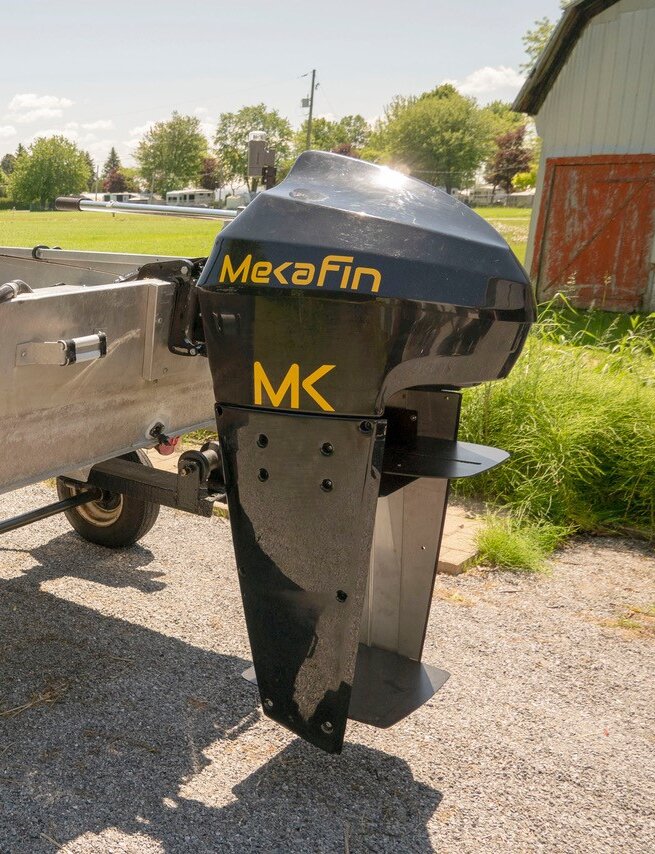
A biomimetic outboard boat motor that replaces the conventional propeller with an oscillating fin — the up-and-down motion of a dolphin's tail. Full design pipeline from sketch to production prototype.
Mekafin is one of the rare projects where the full design pipeline ran end-to-end — from initial sketch through Rhinoceros surfacing, into Solidworks for production-ready engineering, out to blueprints, and finally through supplier coordination in China and Quebec to deliver a working physical prototype.
The product itself is an electric outboard motor with a difference: instead of a propeller, it uses an innovative biomimetic propulsion system that mimics the up-and-down oscillating motion of a dolphin's tail. The mechanical principle was invented and patented by Brice Thouret, who approached Imaginactive with it. Charles Bombardier — founder of Imaginactive and the project's ideator — developed the invention into the Mekafin concept and commissioned the industrial design from IDMR.
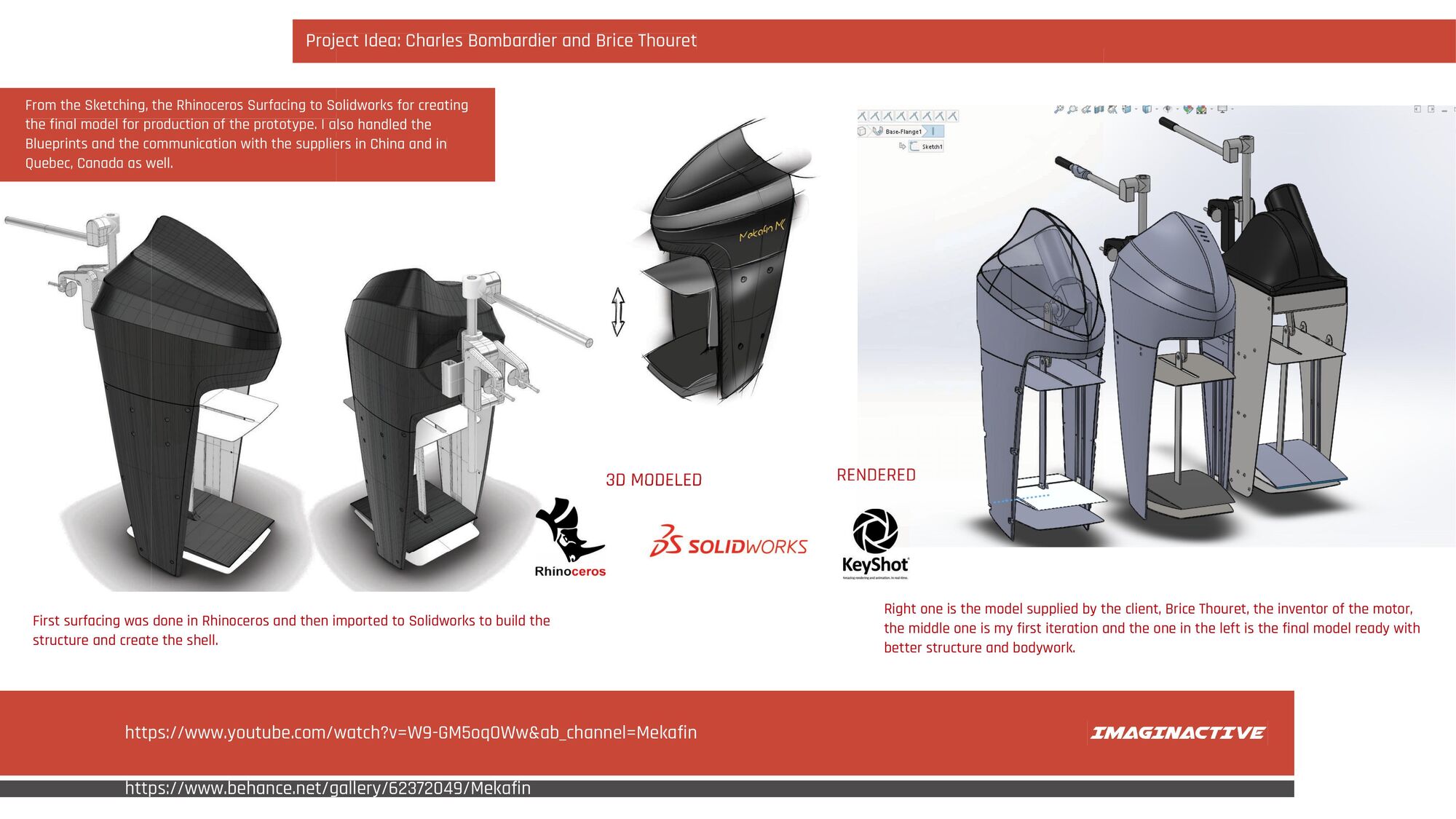
Pipeline: First-pass surfacing in Rhinoceros (the form language of the housing — soft, biomimetic, evocative of a fin rather than a propeller cage). Then imported into Solidworks to build the engineering structure and create a shell that could actually be manufactured. Blueprints and supplier communication handled by me directly, in both China (housing tooling) and Quebec, Canada (assembly).
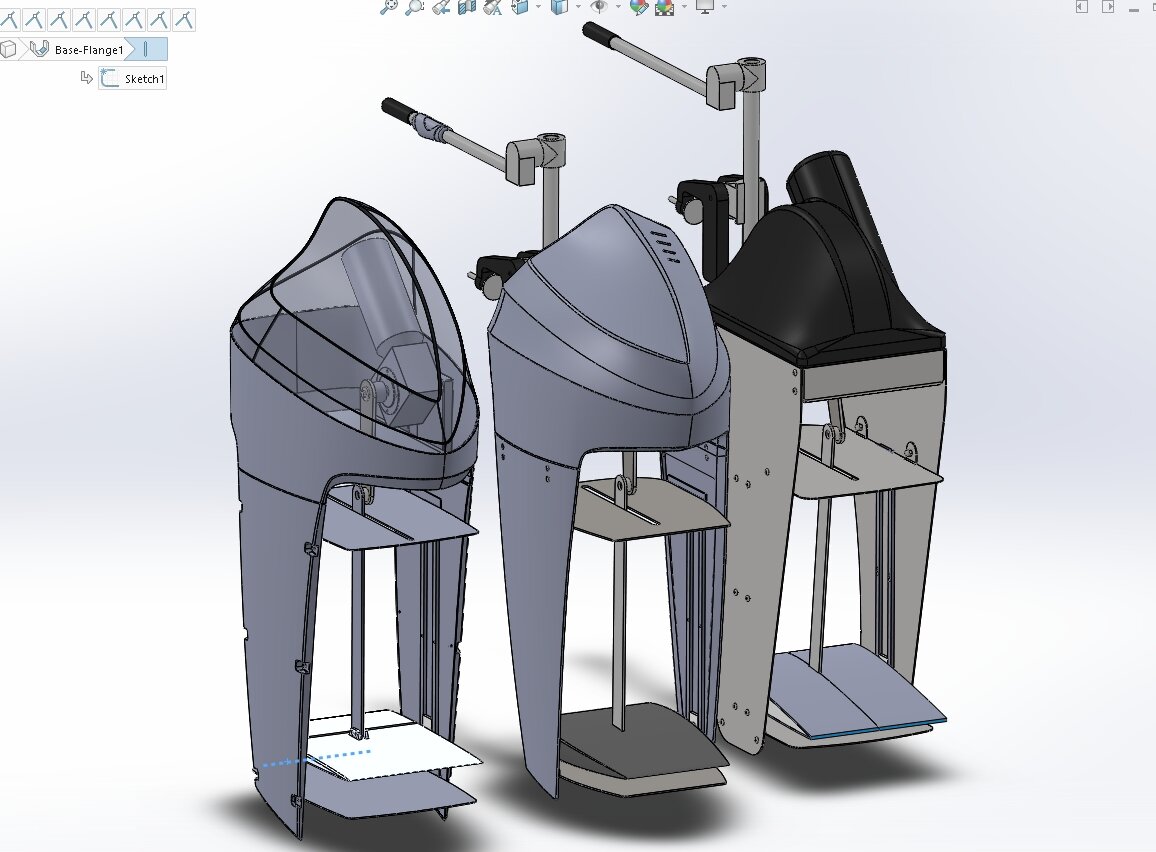
Three iterations are visible in the gallery below: the inventor's original mechanical prototype (right), my first design iteration (middle), and the final design with refined structure and bodywork (left).
Credits — Concept & ideation: Charles Bombardier (founder, Imaginactive). Invention & mechanical principle: Brice Thouret (patent holder). Industrial design, surfacing & prototype delivery: IDMR · Martín J. Rico.
This is the kind of project that grows you as a designer — full responsibility from concept to physical prototype, including supplier coordination across two continents.
The Mekafin outboard motor running through its motion test. The dolphin-tail oscillating fin replaces the conventional propeller — quieter underwater, less harmful to marine life, and surprisingly efficient at low to medium speeds.
The full image set, including additional renders, process notes, and detail views, lives on Behance.
If you're developing a marine product, prototype, or full design-to-manufacture programme — let's talk. Send a brief and we'll come back within two working days.
Request a quote