IDMR / Work / Polestar Dakar .01
Project · Transport · Polestar Design Contest 2024

Polestar Dakar .01.

An all-electric Dakar rally concept submitted to the Polestar Design Contest 2024 — closed monocoque cabin, jacked-up rally stance, oversized off-road wheels carrying the Polestar mark on every spoke. Paired with a Hot Wheels collectible to argue that a brand-builder can live as both a hero render and a die-cast on a shelf.

Sector
TransportRally · EV
Context
ContestPolestar Design 2024
Brand
Polestar× Hot Wheels
Software
RhinocerosUnreal · Adobe
About the project

A rally car you can collect.

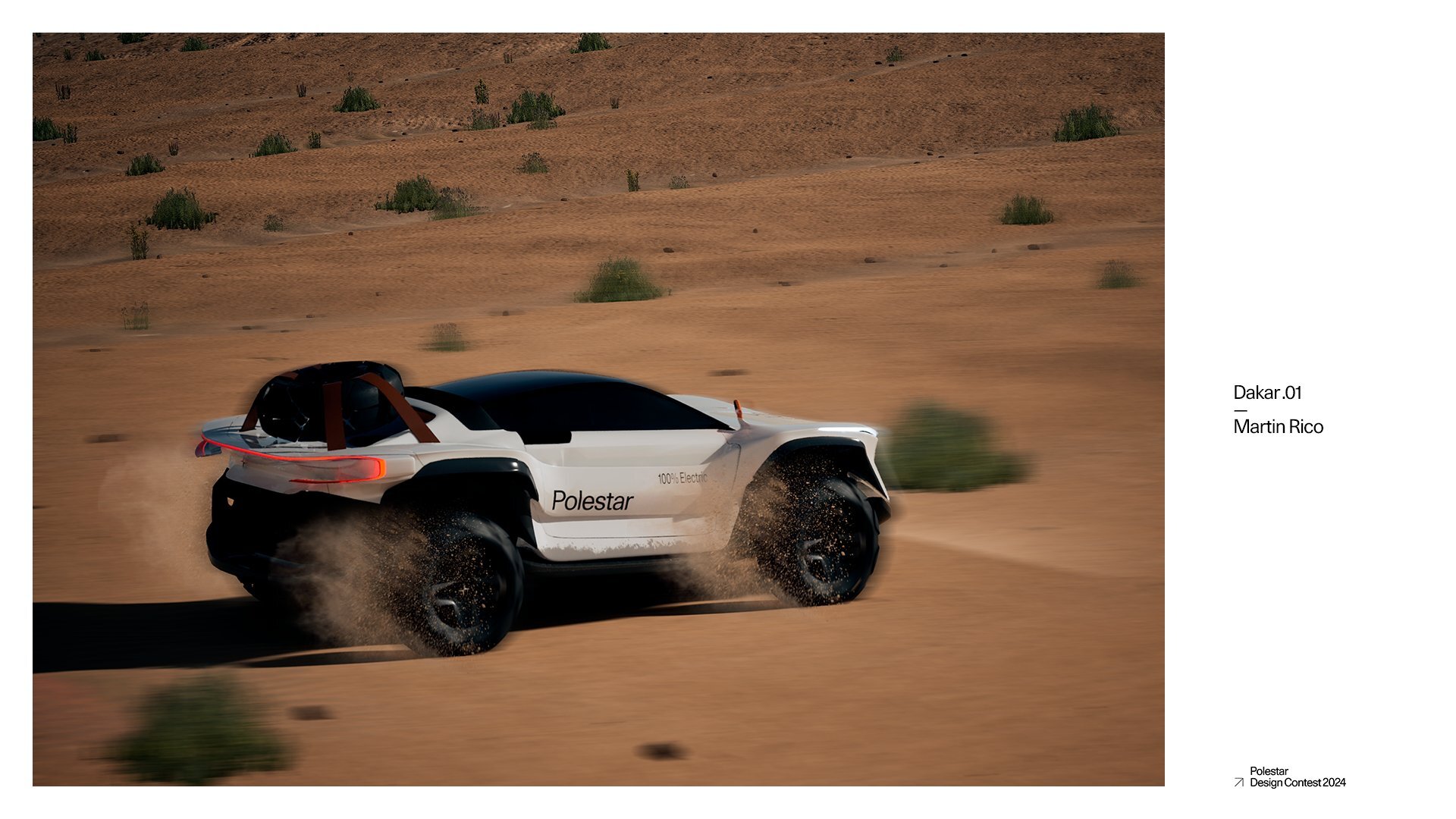
The Polestar Dakar .01 was my submission to the Polestar Design Contest 2024. The brief asked for a vehicle that could carry the Polestar brand into a new territory — so rather than another road-going saloon or SUV, I proposed a closed-cabin, all-electric Dakar rally machine: low, wide, sitting on enormous off-road tyres, with the Polestar mark cut directly into the wheel spokes as a four-fold rotational graphic.

The surface language is deliberately Polestar — long uninterrupted bodysides, a clean black greenhouse that wraps almost all the way down to the rocker, sharp planar haunches over the rear wheels. The rally-specific elements (spare tyre strapped to the deck, leather hold-down straps in oxide orange, the "100% Electric" wordmark on the door) are tools added to a clean object, not styling tricks layered onto it.

Modelled in Rhinoceros using SubD for the body shell and the wheel architecture, surfaced and detailed with NURBS for the rigid panels. Final imagery rendered in Unreal Engine across two locations — soft desert dunes for motion, hard salt flats for product clarity — so the same vehicle could be sold as both an action hero and a static brand object.

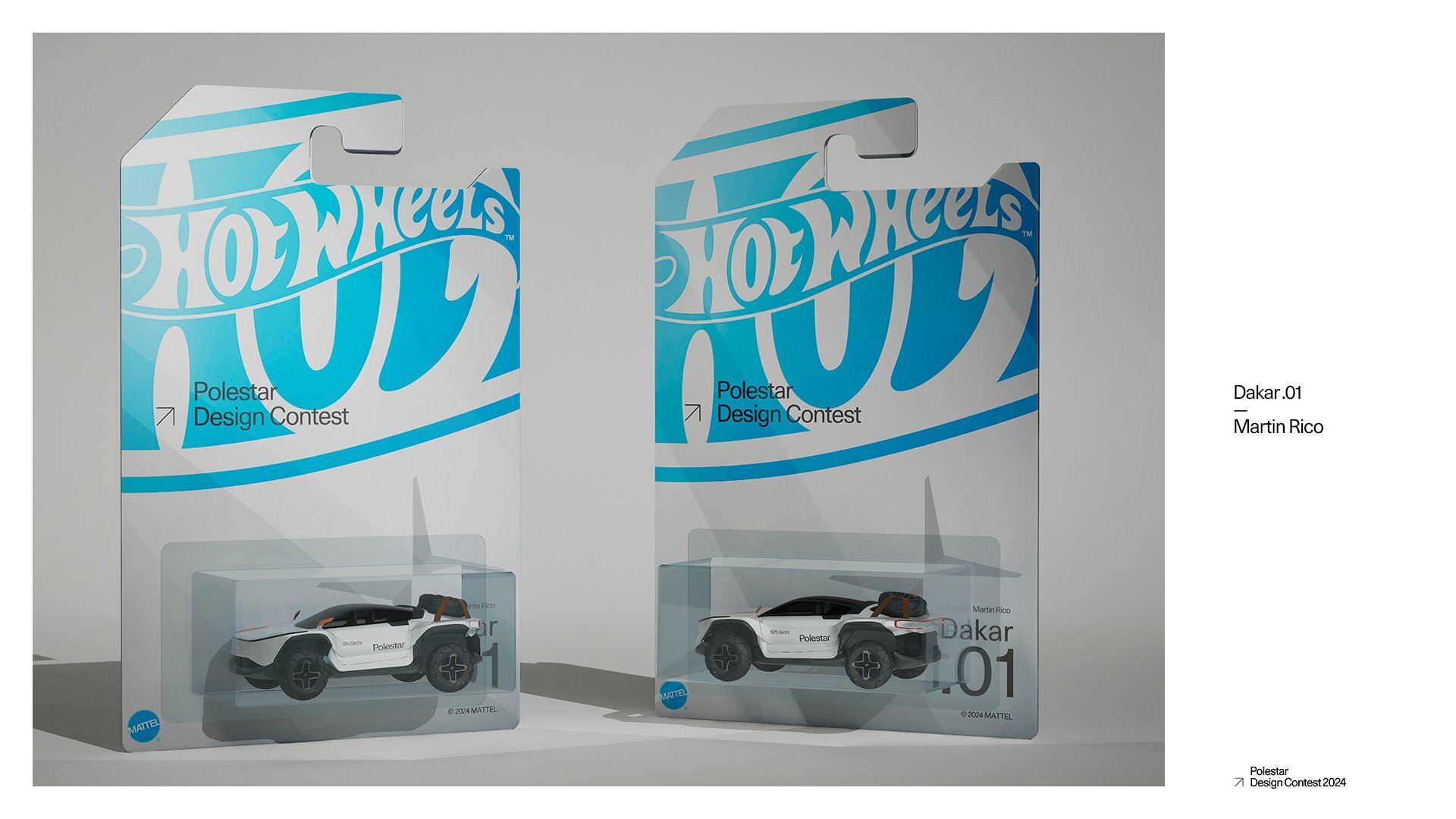
The second half of the submission was a Hot Wheels × Polestar collectible: a 1:64 die-cast of the Dakar .01 in a custom blister pack. The argument: a vehicle's brand value is measured by whether a child wants the toy. If yes, the design has done its real job.
Hero imagery · Two environments

Built for the dust. Photographed on the salt.

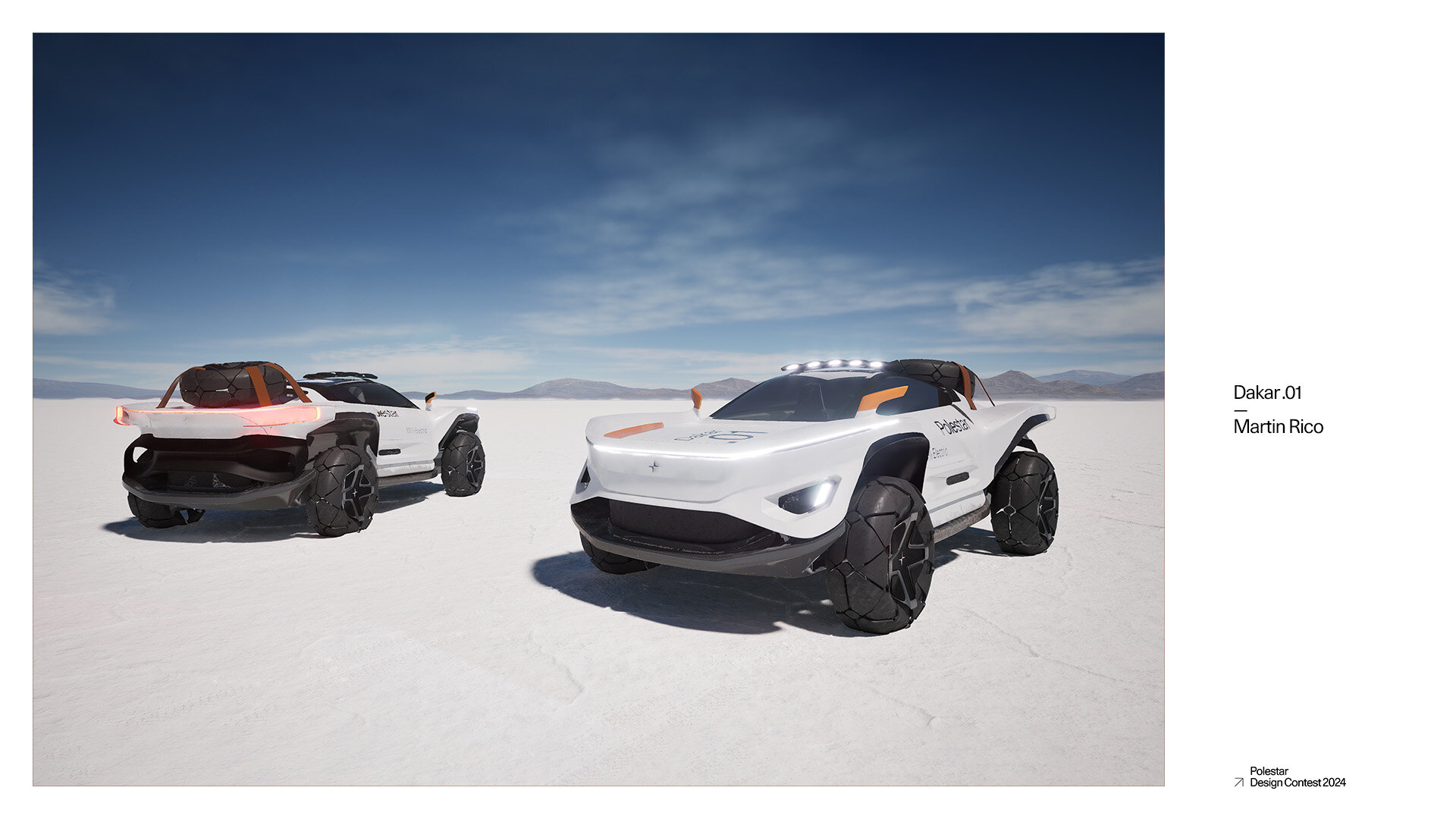
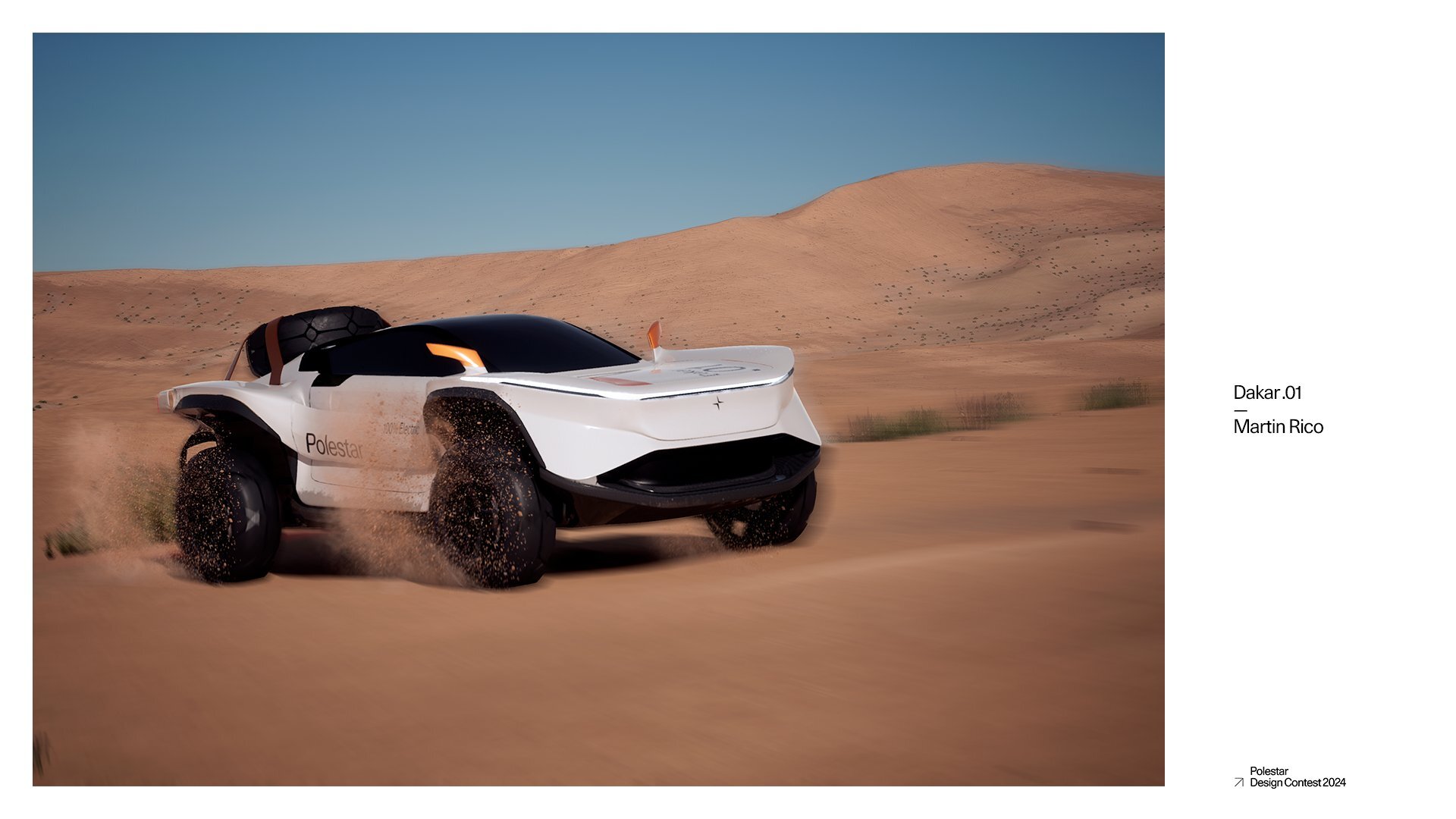
Two render environments doing two jobs. The desert sequence proves the car works in motion — kicked-up sand, blurred backgrounds, low-angle storytelling. The salt-flat sequence isolates the form against an almost-white ground so the volumes can be read cleanly.

RENDER · DESERT
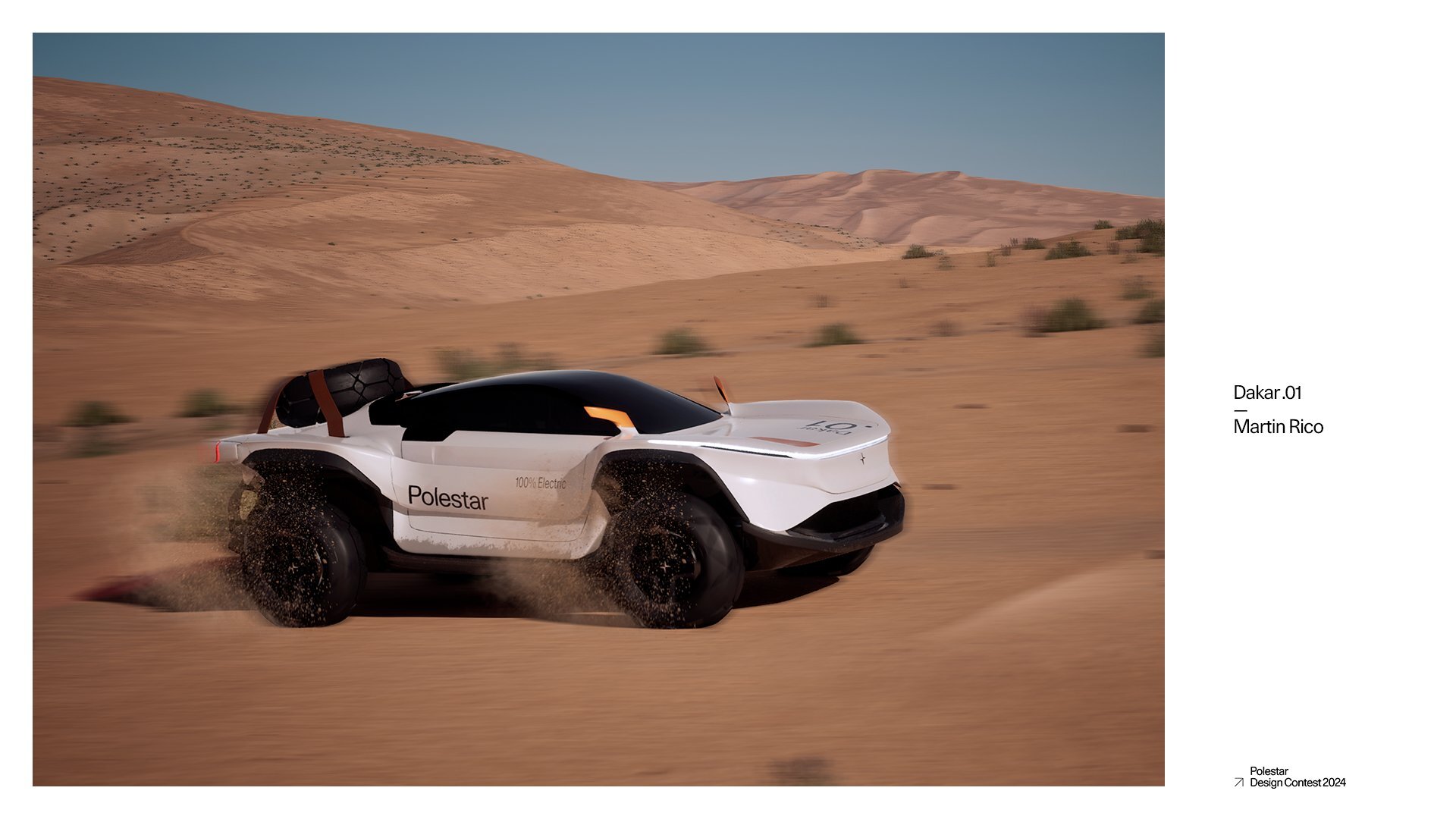
Polestar Dakar .01 in three-quarter front view kicking up dust across a desert at low sun
Three-quarter · dust Low sun, kicked-up sand, the long horizontal body slicing across the dune line. The Polestar mark stays visible through the wheel spokes even at this speed.
RENDER · DESERT
Polestar Dakar .01 in side profile running across desert with motion blur
Side · run Pure profile. Shows the relationship between the closed cabin volume, the wheel-arch cuts, and the strapped-down spare on the rear deck.
RENDER · DESERT
Polestar Dakar .01 rear three-quarter view running across desert
Rear three-quarter The rear deck reads as a flat aero plane with the spare wheel and rally hardware as deliberately applied objects — never integrated, always demountable.
RENDER · DESERT
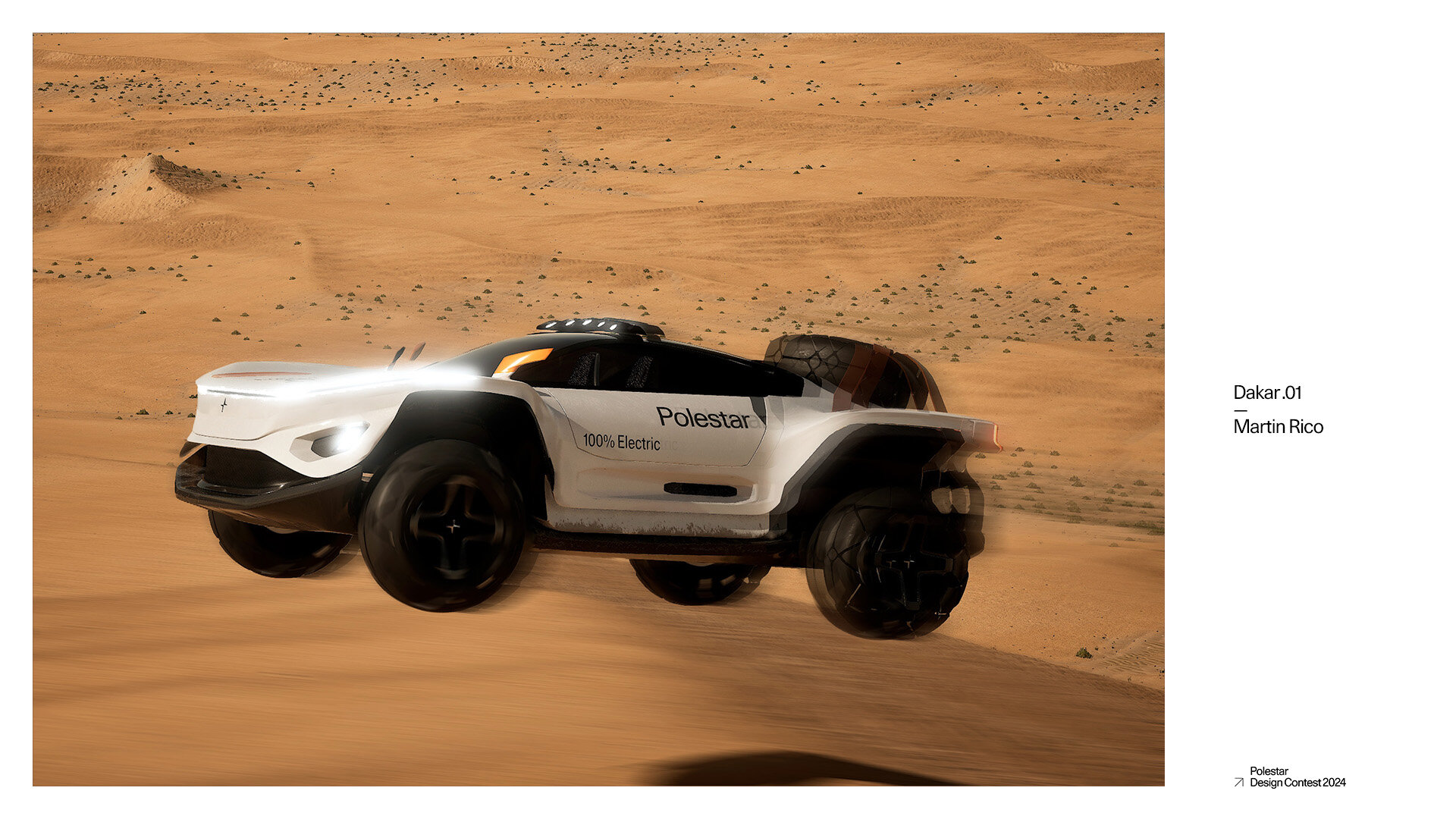
Polestar Dakar .01 airborne over a desert crest at sunset
Crest · sunset Airborne moment. The closed cabin and the heavy off-road tyres tell you this is a Dakar machine before you read the badge.
RENDER · SALT FLATS
Two Polestar Dakar .01 vehicles parked on white salt flats — one front three-quarter, one rear three-quarter
Pair · salt flats Front and rear three-quarter views in the same frame. Designed to communicate a single brand object from both sides at once — useful for press, internal review, and the Hot Wheels pack art.
Brand × toy

If a kid wants the toy, the design works.

Half of the submission was a packaged collectible — a 1:64 die-cast of the Dakar .01 in a custom Hot Wheels blister pack. Treated as a real product, not as a gag: the card art uses the contest typography, the carded back features the Polestar mark, and the toy itself simplifies down cleanly to the volumes you can read in the renders.

The point is that a brand-building concept fails if it only exists as a hero render. A piece of plastic on a shelf has to look right too. That test surfaced real design decisions early — closed cabin instead of open, four-fold rotational wheel graphic instead of a centred logo, hard planar haunches over the rear wheels rather than soft fender forms.

CONCEPT · COLLECTIBLE
Hot Wheels × Polestar · animated reveal The blister pack rotating in product-photography lighting. Pack art, typography, and the die-cast vehicle inside, all working as a single object.
RENDER · PACK ART
Polestar Dakar .01 Hot Wheels blister pack — two units shown side by side with cyan Hot Wheels branding and the Dakar .01 vehicle inside
Blister pack · still Two-up product still. The cyan Hot Wheels mark sits behind the Polestar contest typography — same card, two stocked positions.
Process · Geometry

Wireframe under the render.

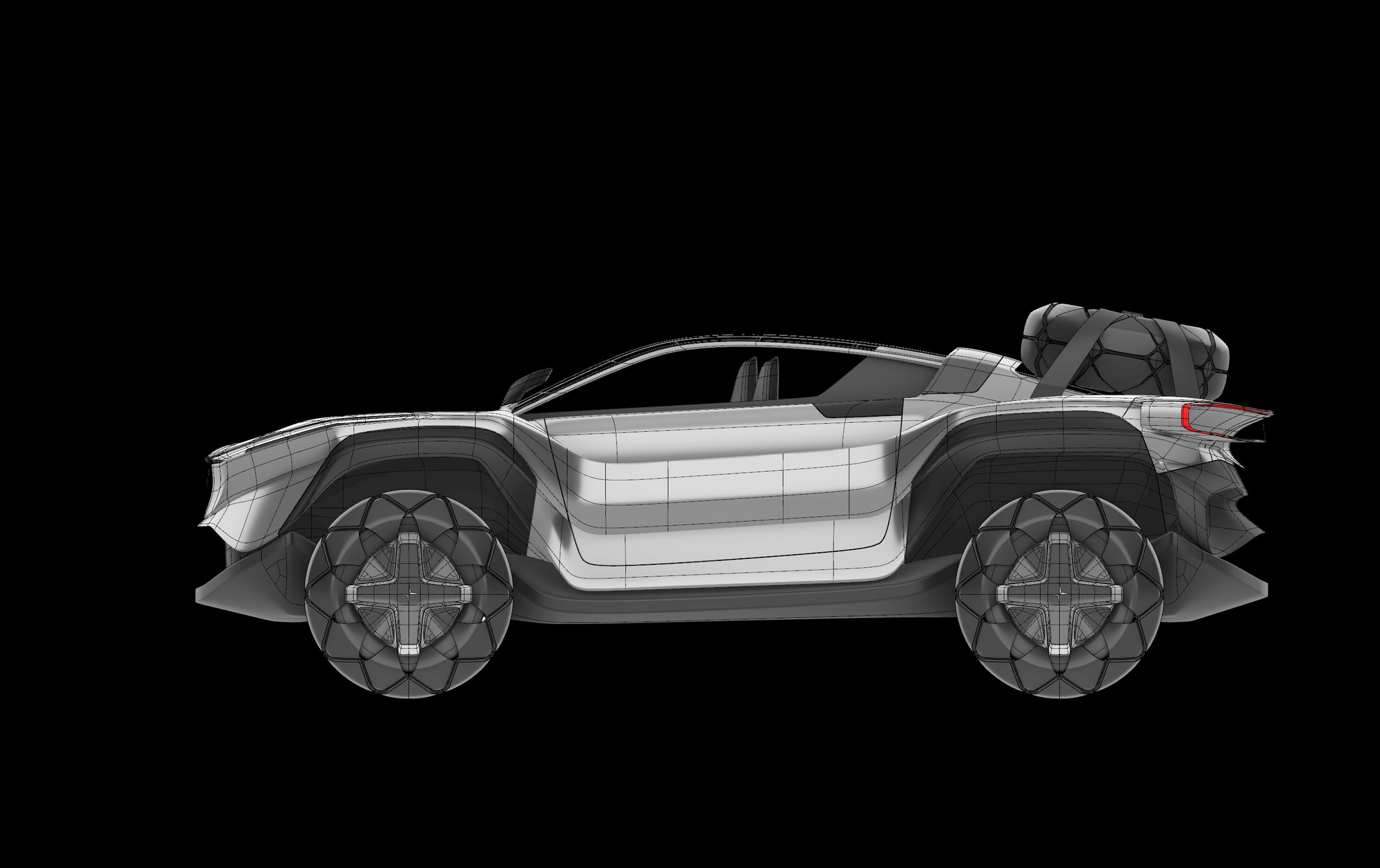
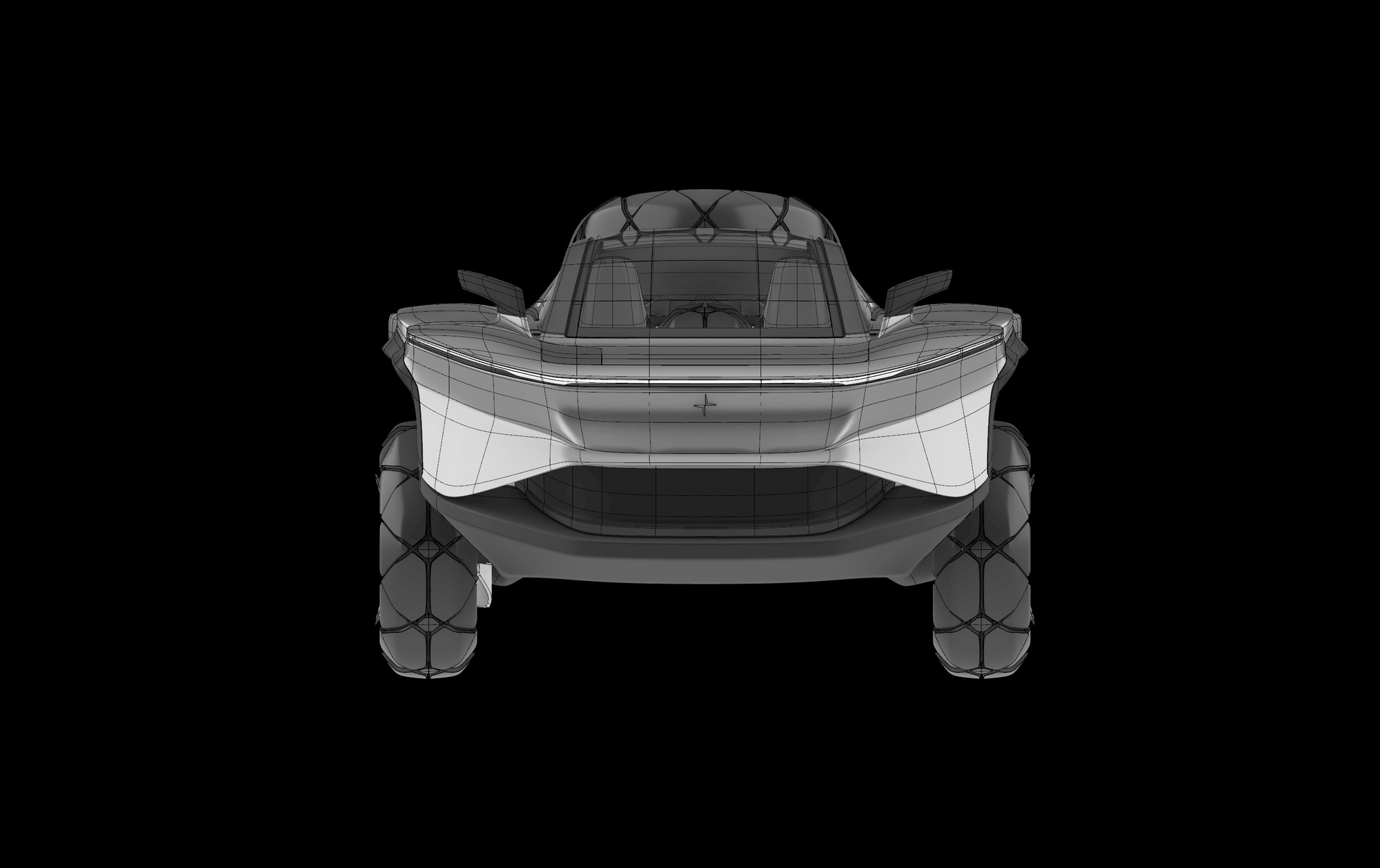
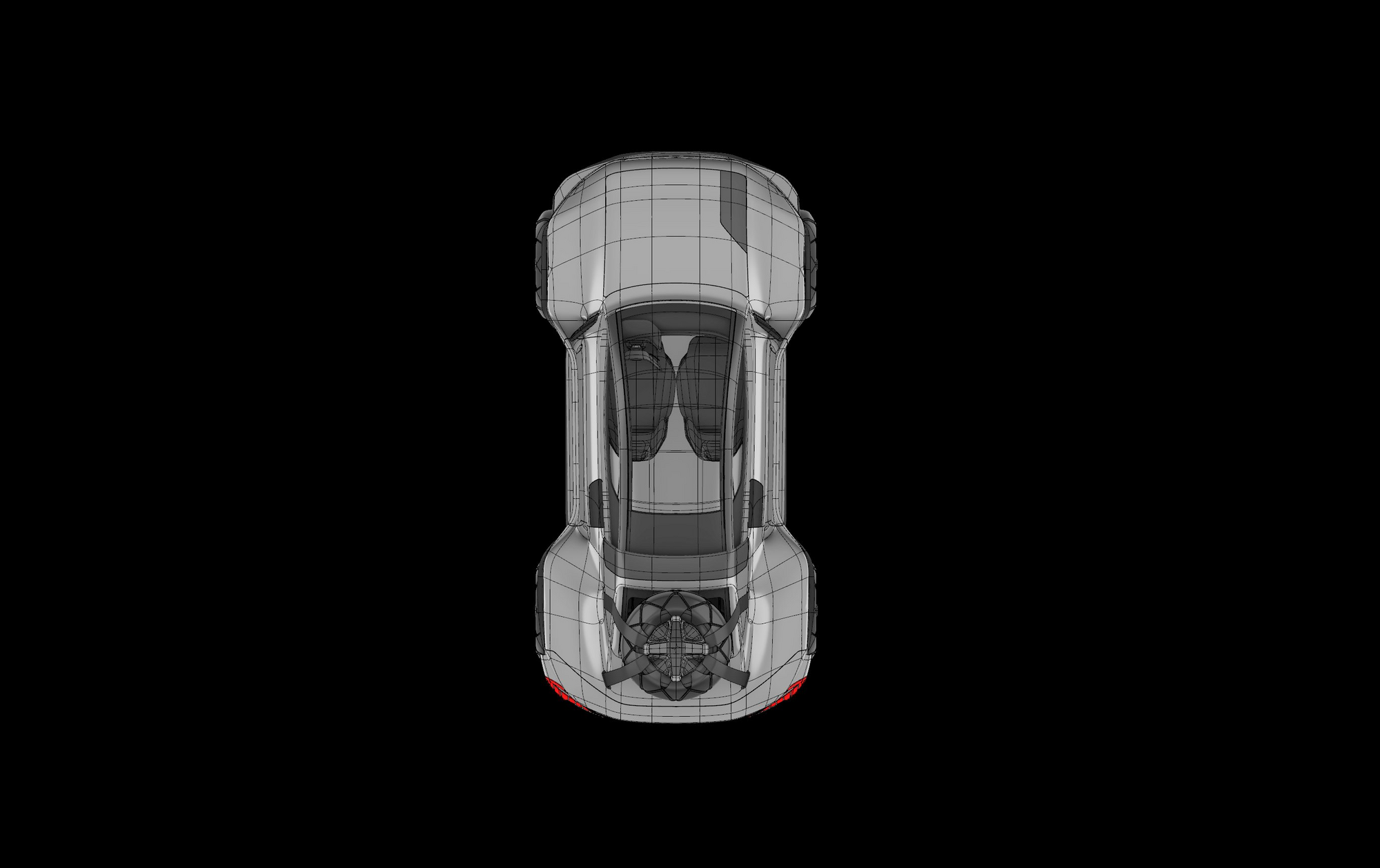
The Dakar .01 was built almost entirely with SubD geometry in Rhinoceros 7 — a workflow that gives you cleanly-flowing surfaces over complex transitions (front bumper to fender, rocker to rear haunch) without the seams that fall out of NURBS surfacing when surfaces fight each other.

Three views below show the underlying topology. The wheel architecture is a single rotationally-symmetric module — five-fold radial pattern with a four-arm Polestar mark cut into the centre as the only deliberate break in the rhythm.

MODEL · SIDE
Wireframe view of Polestar Dakar .01 from the side showing SubD topology
Side view · topology The clean side surface is a single SubD body wrap. Every panel cut visible in the render is a deliberate line, not a modelling artefact.
MODEL · 3/4
Wireframe view of Polestar Dakar .01 in three-quarter view showing geometry
Three-quarter · geometry The transition from front fender to door to rear haunch reads as one continuous surface, with the rally hardware applied as discrete objects.
MODEL · TOP
Wireframe view of Polestar Dakar .01 from above
Top view · plan Wheels pushed to the corners of the platform. The closed cabin sits centred along the longitudinal axis — symmetrical, simple, and short.
Process · Real-time

Same model, in Unreal.

The same Rhino model was taken into Unreal Engine for a real-time visualisation pass — a sequence that drops the vehicle into multiple environments without re-rendering. Useful for review and for arguing that the surface language survives any light, any ground, any backdrop.

The clip below walks the car through the level transitions used during the contest pitch.

UNREAL · LEVEL SEQUENCE
Unreal Engine · level switch Real-time visualisation across multiple environments. Audio on.
External · Full gallery

See the complete project.

The full image set, including additional renders and process notes, lives on Behance.

VIEW ON BEHANCE ↗

Working on something similar?

EV concept, motorsport programme, or a brand-building hero vehicle that also has to live on a collector's shelf — send a brief and we'll come back within two working days.

Request a quote