IDMR / Work / Unimog Rover
Project · Transport · Politecnico di Milano

Unimog Rover.

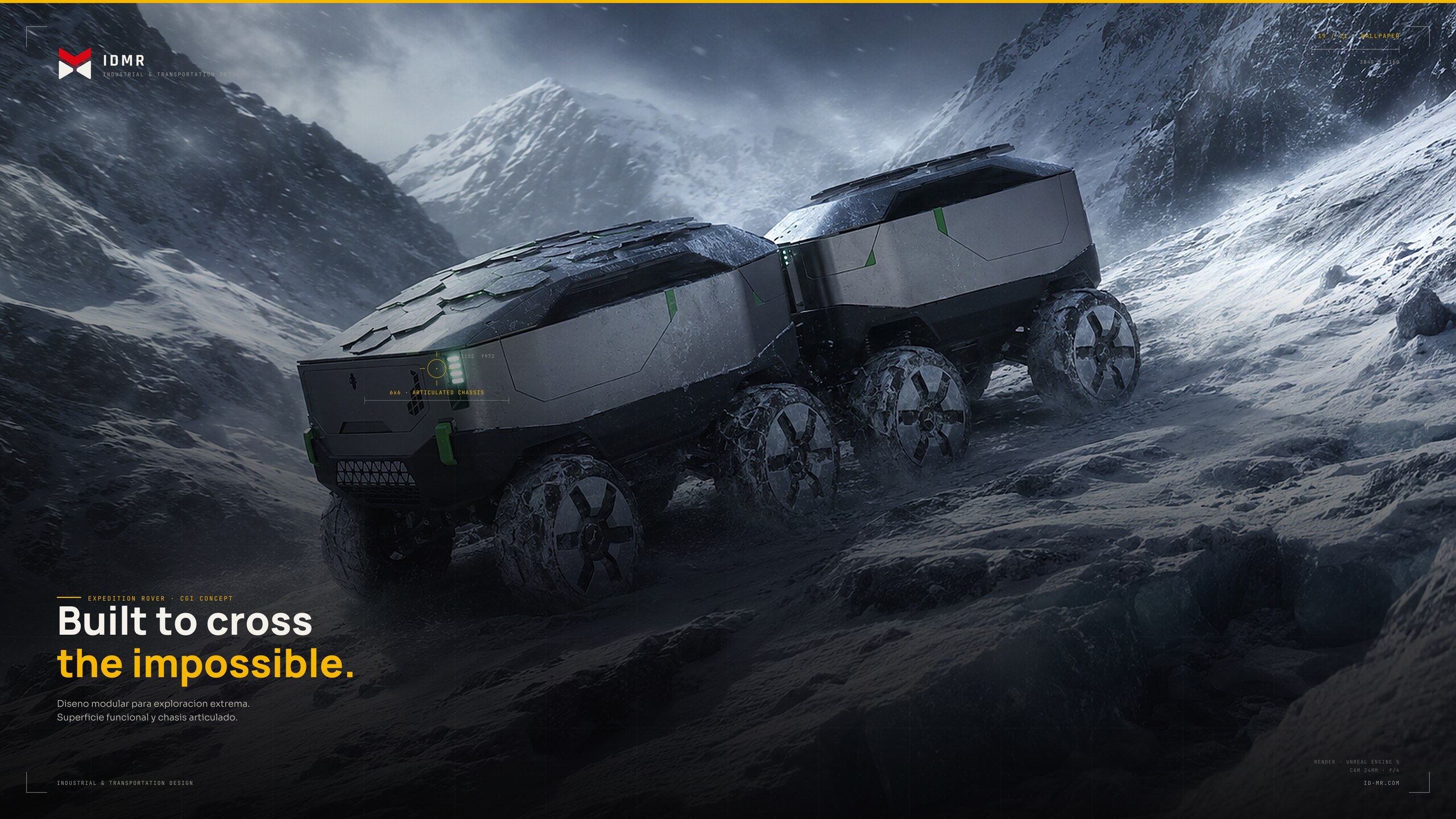
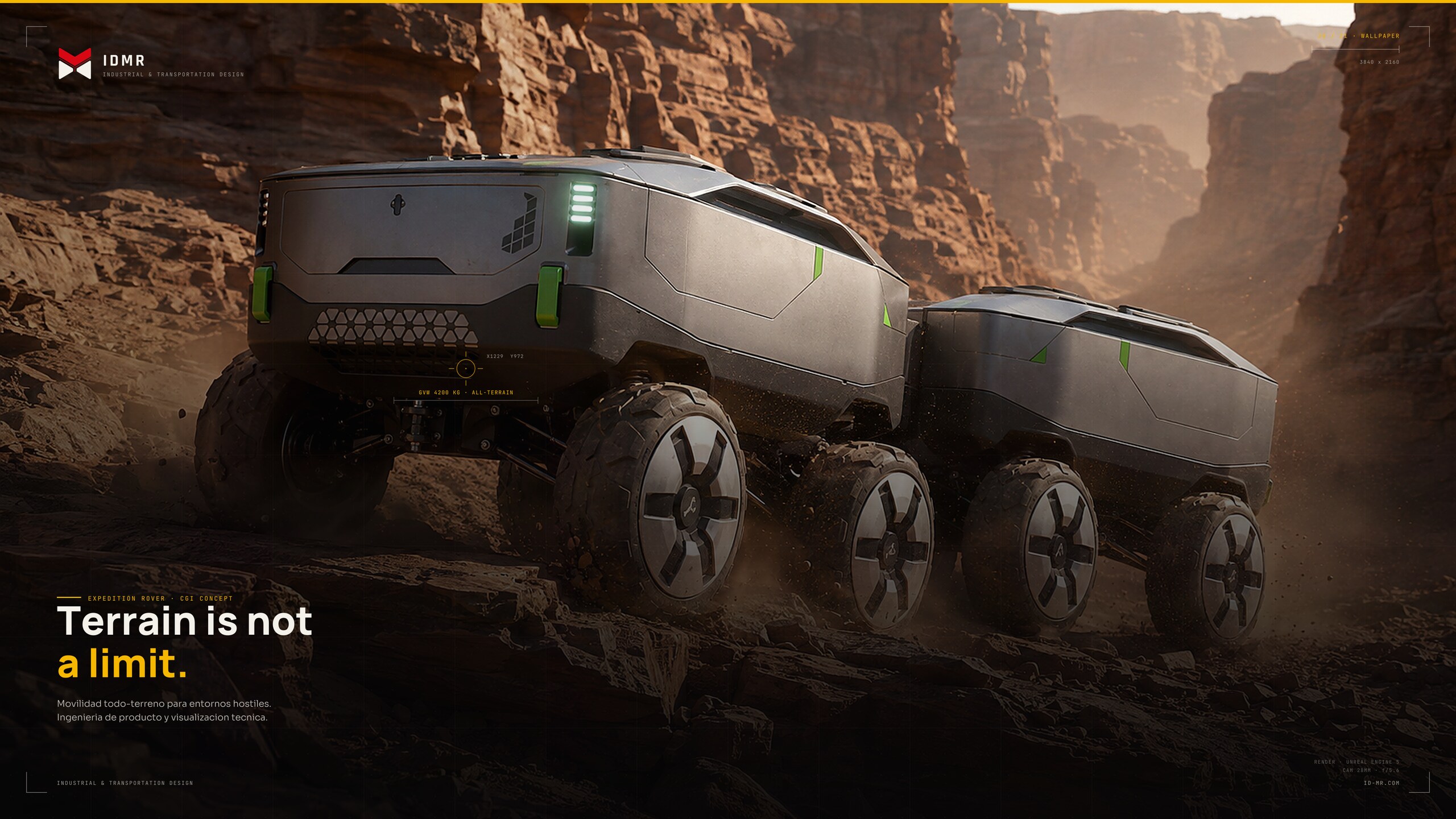
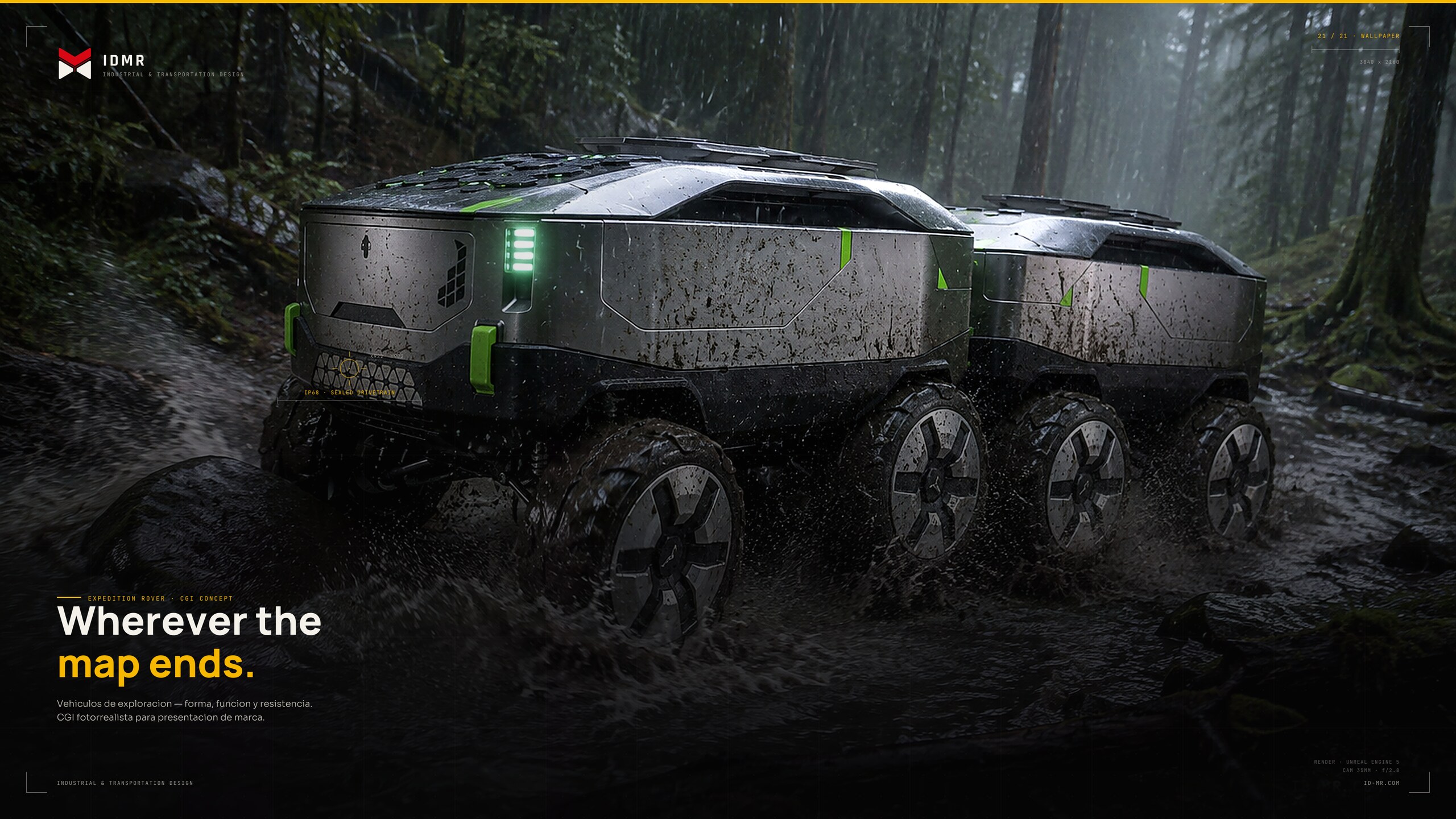
A modular, all-terrain expedition vehicle for sustained life off the grid. Detachable living, power, cargo and SLS 3D-printer modules slot onto a single hexapod platform. Terrain-adaptable wheels, full solar deck, beetle-inspired surface architecture. Developed as a team project at Politecnico di Milano, taking the Fremen ethos in Frank Herbert's Dune as a starting point.

Sector
TransportExpedition · Off-grid
Scope
TeamPolitecnico di Milano
Inspiration
DUNEFremen · Frank Herbert
Software
RhinocerosUnreal · Adobe
About the project

One platform. Many modules.

The Unimog Rover is a personal concept for a modular all-terrain expedition vehicle — a single rugged platform designed to be reconfigured by swapping body modules on and off. The driver core stays fixed; everything behind it is interchangeable: a Living Module for crew rest, a Power Station with a deployable solar deck, a Cargo Module for supplies, an SLS 3D-Printer Module for fabrication and on-site repair.

The visual language is deliberately beetle-inspired — exoskeleton-like hard plates over softer underbody volumes, hexagonal segmentation across the solar deck, a stance that reads as armoured rather than aerodynamic. Every module shares the same hexagonal grid language so they read as one family even when separated and parked across a camp.

Modelled in Rhinoceros using SubD for the body shells and the terrain-adaptable wheel architecture, with NURBS surfacing for the rigid plate elements. Rendered in Unreal Engine across multiple compositions — assembled road train, exploded module camp, top-down orthographic, motion three-quarter — to test the design from every angle a brief like this would demand.

Team project — Politecnico di Milano. Developed with Riccardo Portelli and Akhil Piyush. Surface design, modular architecture, and renders by Martín Rico.

A fan concept inspired by the Fremen of Frank Herbert's Dune. Not affiliated with, endorsed by, or commissioned by the rights holders to the Dune franchise or the Unimog/Mercedes-Benz marks. Academic project, no commercial use intended.
Imagery · The camp

Built to park apart.

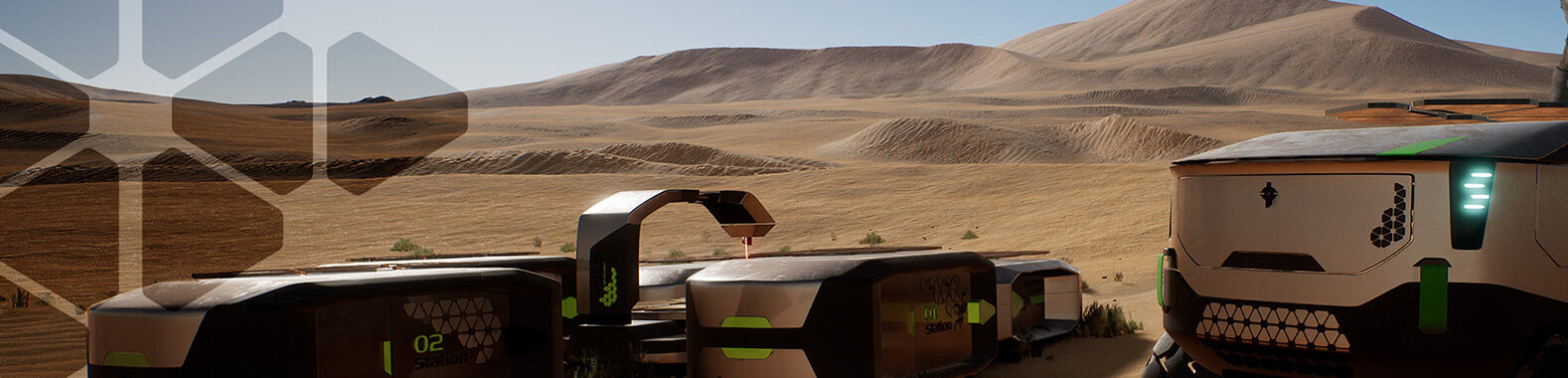
The Rover never lives as a single object — it's a family. Driver pod up front, swappable modules behind it, the whole convoy able to detach and spread out as a desert camp when stationary. The hexagonal segmentation, the colour palette, the lighting language all stay consistent so the camp reads as one entity even when its parts are sitting twenty metres apart.

RENDER · CAMP WIDE
Unimog Rover concept — modular vehicles arranged in an open desert camp configuration
Desert camp · wide Two driver pods parked beside detached modules. The numbered station labels (01, 02) on each unit are an in-universe wayfinding system so crew can find specific modules quickly in dust or low light.
RENDER · ROAD TRAIN
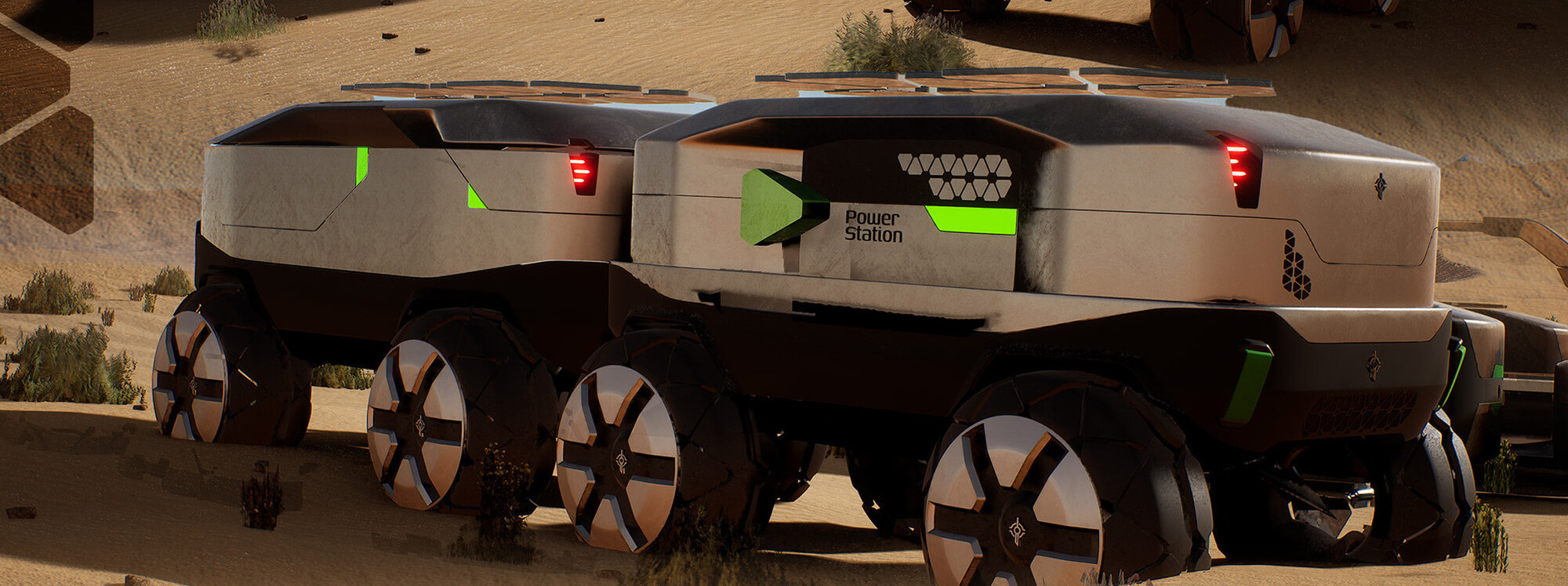
Unimog Rover concept assembled as a multi-axle road train in side view, with Power Station module visible
Road train · assembled Two units linked into a multi-axle road train. Solar deck running the full length. The exposed wheel architecture — eight oversized off-road wheels visible — is the dominant graphic of the side view.
Modules · System architecture

Four bodies, one chassis.

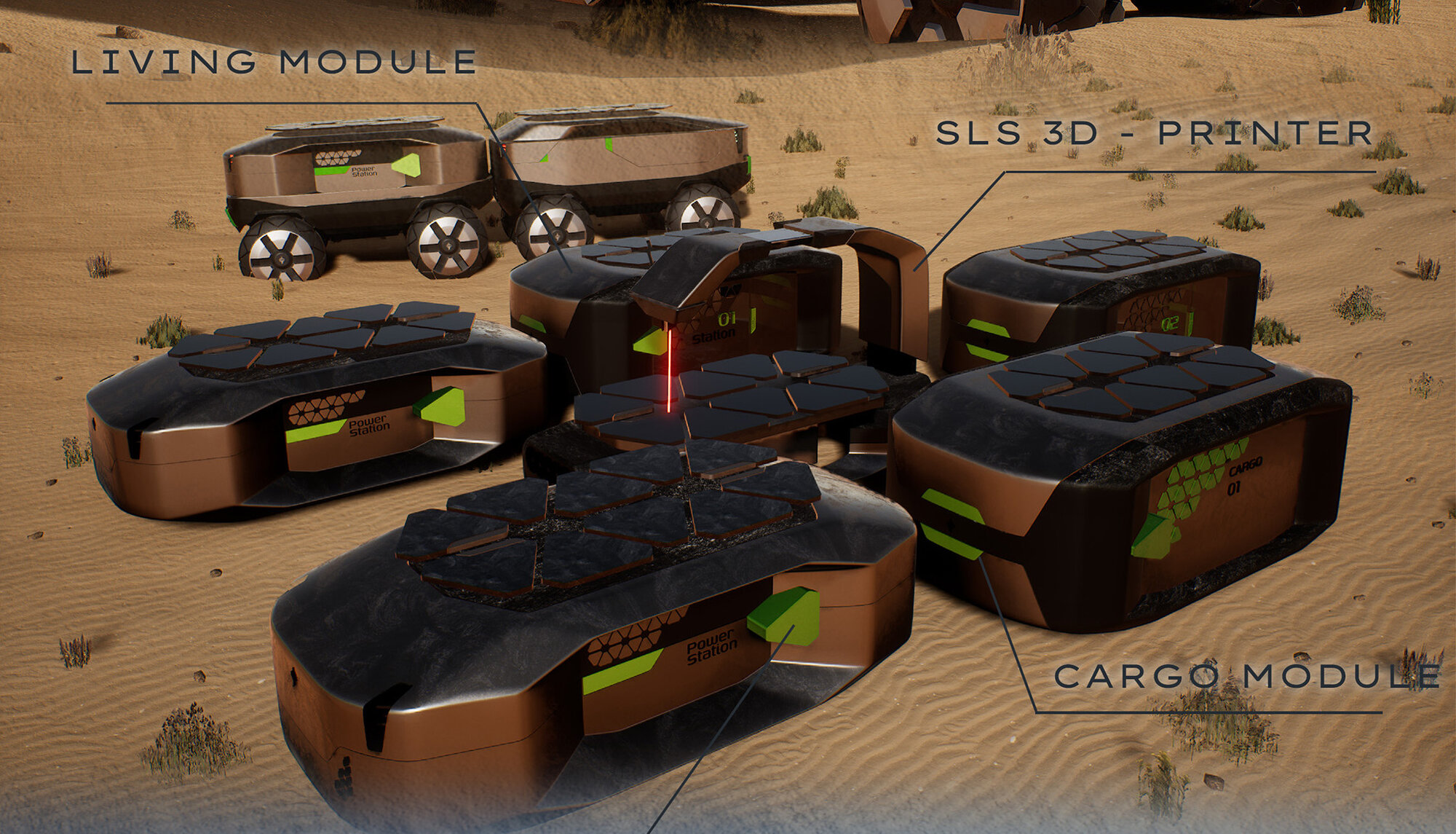
The platform is designed around four module types, each slotting onto the same chassis interface. None of them tries to do everything — each is purpose-built so the rover only carries what the mission needs.

Living Module houses crew rest, life support, and habitation. Power Station is a high-capacity battery bank with a deployable solar deck. Cargo Module is a sealed bay for tools, supplies, sample storage. The SLS 3D-Printer Module is the strangest one — a small selective-laser-sintering fabrication bay so the expedition can manufacture replacement parts on-site without resupply.

Critical for survival logic, narrative for the Fremen reference: a culture that lived on scarcity would value the printer more than the living quarters.

DIAGRAM · MODULES
Unimog Rover concept modules — Living Module, SLS 3D-Printer Module, Cargo Module, Power Module — annotated diagram view
Module family · annotated Four module types around a central SLS printer station. Each module shares the same hexagonal grid graphic on the side panels so the family is visually coherent even when separated.
Imagery · In motion

Terrain-adaptable everything.

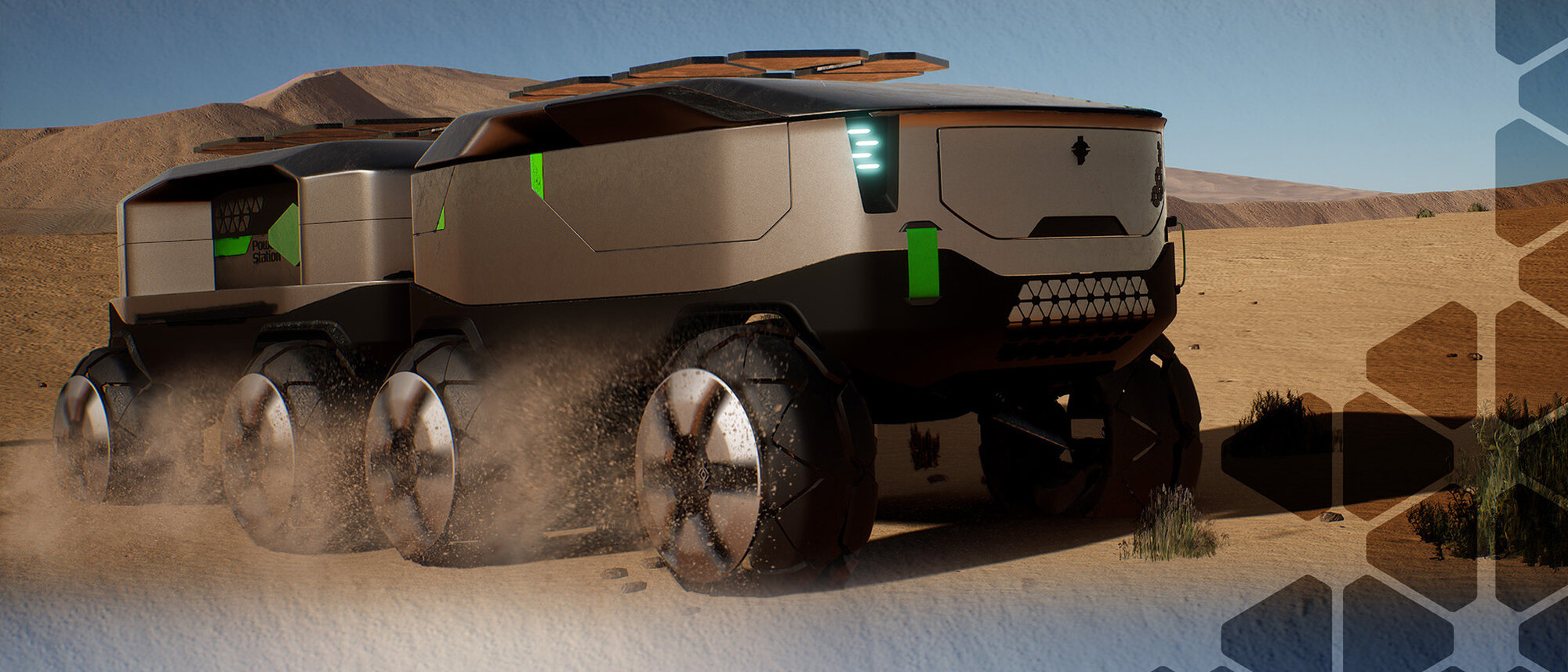
The wheels are the heart of the vehicle — oversized, individually articulated, with a hexagonal tread pattern that reads as a graphic even at speed. Each wheel can adapt to terrain independently, allowing the platform to crawl over rock, sand, or compacted dust without sacrificing the level cabin.

RENDER · THREE-QUARTER
Unimog Rover concept moving through desert kicking up dust, three-quarter front view showing rover and one trailing module
Three-quarter · dust trail The platform with one module attached, in motion across packed desert. The closed driver cabin, hexagonal grille graphic, and tucked-up suspension all read clearly at speed.
RENDER · AERIAL
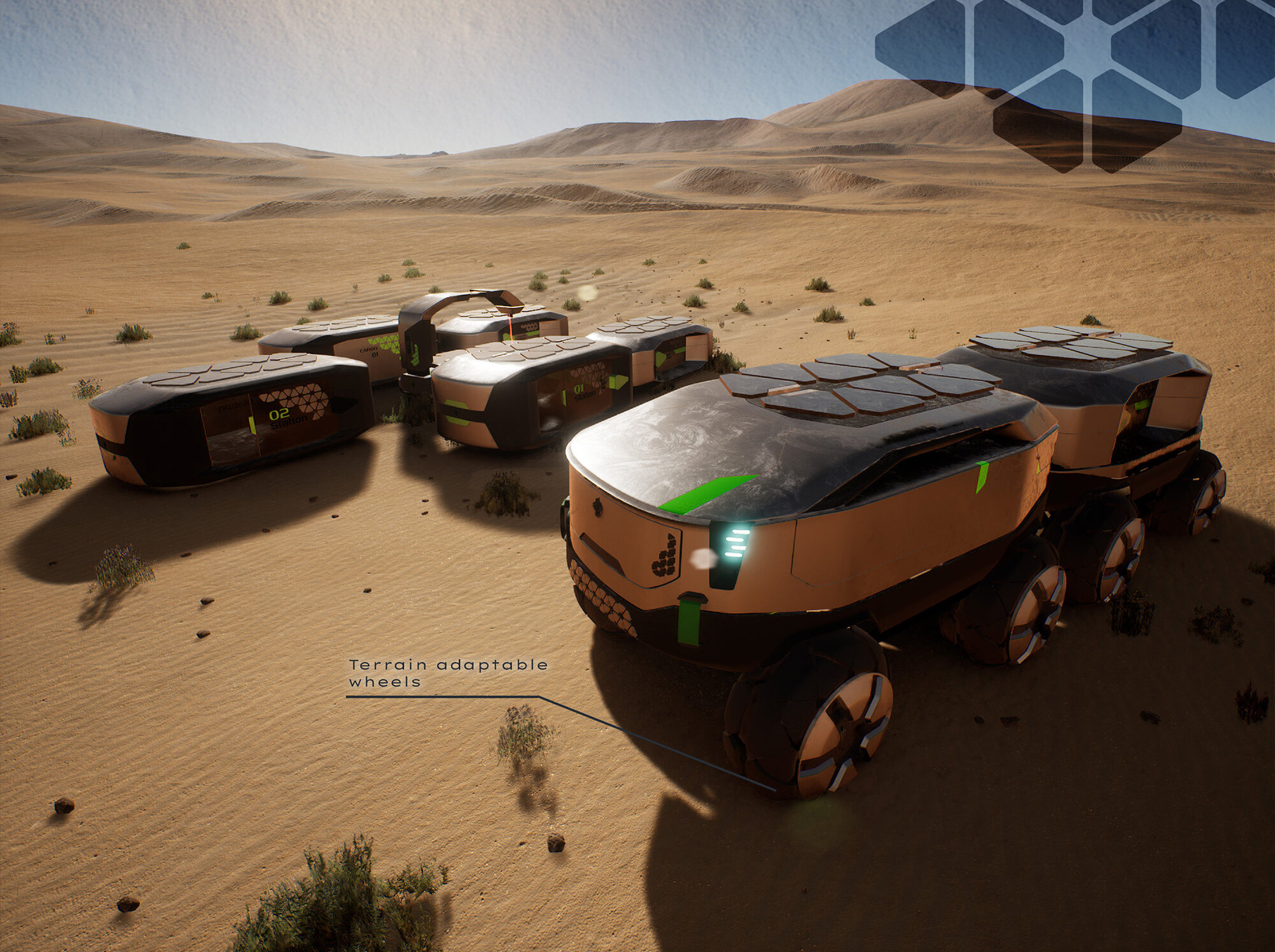
Aerial view of Unimog Rover modules spread across desert terrain with terrain-adaptable wheels callout
Aerial · camp spread From above, the relationship between the modules and the parent platform becomes obvious — the solar deck reads as a continuous graphic across the whole family.
Specification · Orthographic views

Front, side, top — and dimensions.

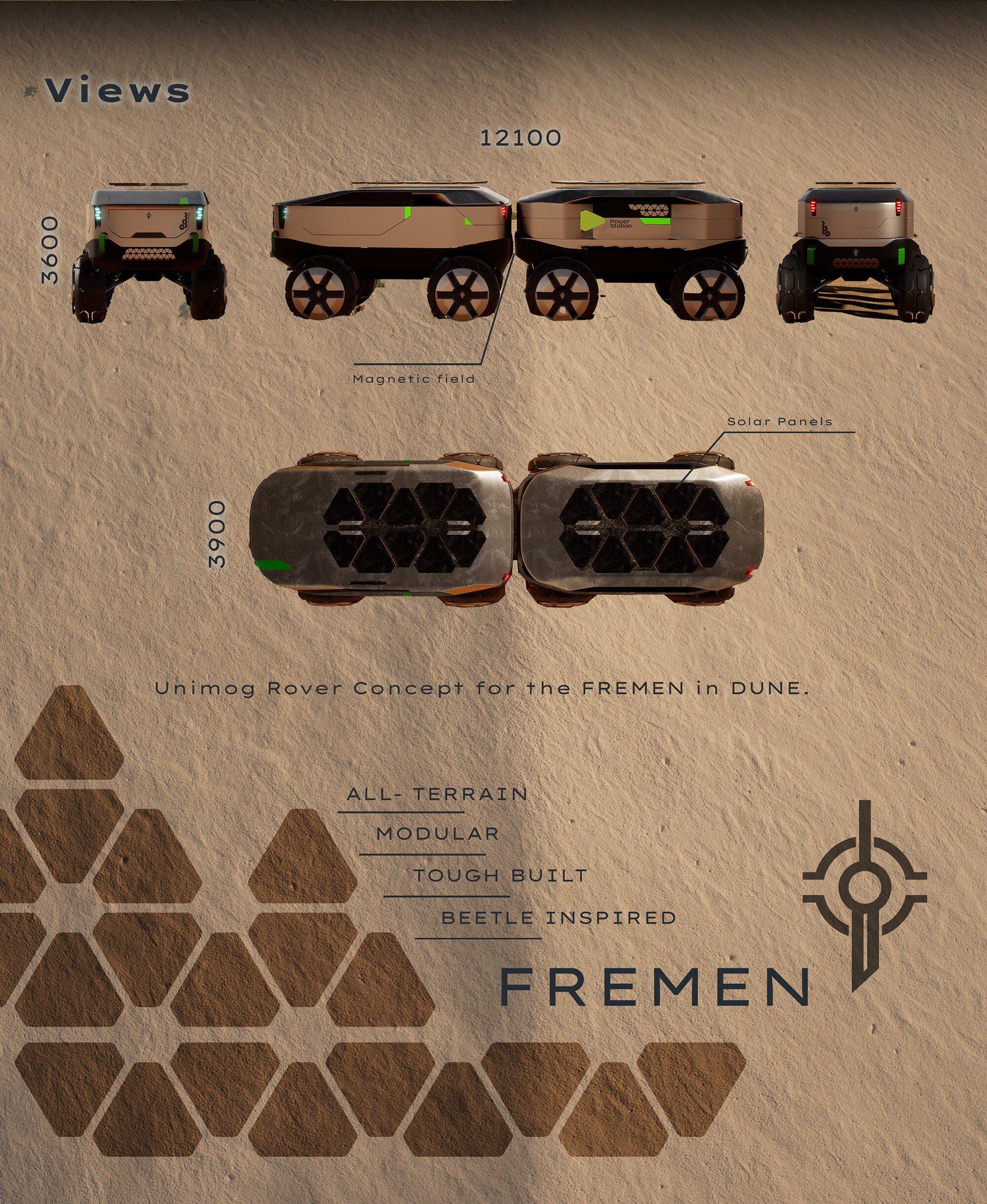
Final spec sheet from the project — front and rear elevations, full side profile, plan view from above, overall dimensions, and the design pillars that drove every decision: all-terrain · modular · tough built · beetle inspired.

The "Fremen" sigil on the right is an original mark designed for this project as an in-universe faction emblem — a four-point directional graphic around a central node, meant to read as a tribal symbol from any rotation.

DRAWING · TECHNICAL VIEWS
Unimog Rover technical specification sheet showing front view, full side road train at 12100mm length, rear view, top view at 3900mm width, height 3600mm, and design pillar callouts: all-terrain, modular, tough built, beetle inspired. Fremen sigil at lower right.
Views · 12100 × 3900 × 3600 Full road-train length 12,100 mm. Width 3,900 mm. Height 3,600 mm. The two modules read as one continuous object from above thanks to the solar deck graphic.
External · Full gallery

See the complete project.

The full Unimog Rover image set, including additional renders and process notes, lives on Behance.

VIEW ON BEHANCE ↗

Working on something similar?

Expedition vehicle, modular platform concept, or a brand-fiction project that needs to feel like it could actually exist — send a brief and we'll come back within two working days.

Request a quote